Showing posts with label South Korea. Show all posts

Tuesday, April 19, 2011

Kimchi!

On a whim we decided to book a flight to South Korea’s version of Hawaii, Jeju-do. It’s got pristine beaches, ancient volcanoes, knobby tangerines, and waterfalls pouring directly into the ocean: everything you need for an island vacation except little drink umbrellas. Deep down, though, we were just hoping that we’d find someplace in Korea that was actually warm— sadly, it turned out to be too cool to break out the bathers.

Our wanderings led us down a 1km-long lava tube, to the top of an extinct volcanic caldera, and along a gravity-defying road where cars seemed to drift uphill. Everywhere we went, the South Koreans seemed to be enamored with us and often had us pose in pictures, making the ubiquitous Asian V with our fingers as they shouted, Kimchi! Our bestest friend of all, though, was the lady at the bus station. When we arrived filled with the fragile hope of finding our lost camera, she smiled and understood our inept gesticulations enough to direct us to a back room where, lo and behold, some honest soul had returned it. In no other country we’ve visited could we have even dreamed of such a lucky outcome— again, it speaks to the quality of the Korean people.
The last night on the island we witnessed a street taekwondo brawl and sated our adrenaline with a ridiculously juicy, fatty, Korean-barbequed black pig. Ahh, contentment.


Wednesday, April 13, 2011

Twins!

Back when I was a kid, my mom used to dress me and my older sister in matching clothes.  Seems fair considering just how cute we looked dressed up all twin-like.  Exhibit A:
In fact, I must admit that I am guilty of occasionally buying my nieces matching outfits.   What can I say? I can’t help it.  Anyway, having firmly believed that this was a craze reserved only for children, South Korea has surprised me once again!  Indeed, people everywhere yearning for a world in which matching clothes is not just a childhood fancy should definitely move here.


I can’t help but wonder if the girl that gets her boyfriend to wear a matching t-shirt looks enviously at the girl who gets her boyfriend to also wear matching jeans and shoes.  Perhaps the seriousness or happiness of each couple’s relationship is based on how much they match.  Either way, Juan and I must look pretty happy with our matching jackets.  :)

Saturday, April 9, 2011

Modern-day pyramids

We hadn’t read much about Gyeongju before arriving, but perhaps even if we had, we would not have been prepared for the sight of the 4th century Shilla burial mounds that rise like sentinels out of the Gyeongju landscape. Beautiful and eerie, it’s like stumbling into a Lewis Carroll poem… Built by piling rocks up to 22 meters high and packing dirt on top, they store the remains of Shilla monarchs and their families. Obviously grassy hillocks are a bit more subtle than pyramids rising from the starkness of the desert, but certainly they deserve a little more attention!


We also explored the beautiful Bulgak-sa temple, reputedly one of the best examples of Shilla architecture although, admittedly, we were more intrigued by the mysterious stacks of rocks near one of the shrines than the intricate woodwork.


If only our food explorations in Gyeongju were so grand… We attempted to find a Korean BBQ place recommended by our Norwegian sunmudo teacher but, having only vague directions and no name (as if we could read one anyway), it was a hopeless cause. Luckily, the Pizza Hut we spotted on our long search was still open (and packed with people). Americanization saves the day!

Monday, April 4, 2011

How to run a Love Motel


Like technology for Japan, South Korea is at least five years ahead of the US with its own titillating industry: love motels. They’re everywhere. We found one near the Gyeongju bus station (naturally) that came recommended by LP and Tia is threatening to move in for good. Here's why:


1.  Popcorn machine in the lobby
2.  Dark glass reception window painted with a lascivious pixie and a small hole at the bottom where you duck your head to ask for a room (yes, they seem surprised when you want to stay a whole night -- yes, a whole night -- yes, for sleeping)
3.  Profound, nonsensical quotes on the hallway walls (e.g. “A life without love, without the presence of / the beloved, is nothing but a mere magic-lantern show”)
4.  Suite with magic-castle-in-the-forest theme
5.  Free bottle of Korean port
6.  Mirrors on the ceiling (obviously)


7.  Mood lighting, e.g. glittered ball on bathroom ceiling softly changing colors
8.  Complete array of free men’s products: after shave, cologne, hair spray, facial cleanser, condoms, shoe horn
9.  Heated toilet seat with special spray settings for women


10.  Full hair product suite for women – Vidal Sassoon shampoo and conditioner, hair dryer, round brush, hair spray, smoothing gel, spare hair elastics, etc.
11.  Enormous flat screen TV with all sorts of channels (wink, wink)
12.  Full spa bathtub with two headrests and accompanying hot pink bath salts
13.  Loads of other free stuff!


The place screams of sketchiness and class at the same time (the numbers for hookers on the outside door make it lean more toward the former).  Still, after a few days of sleeping on floors, this is perhaps the best $55/night we have ever spent.  

Saturday, April 2, 2011

Wax on, wax off


When I first told my mom that Juan and I were headed to a Buddhist temple for a few days, her response was, “How relaxing.”  As it turns out, not so much. 

Each day began with morning chanting at 4:30am.  If you were even a minute late, you must perform 3000 bows – a process which reportedly would take from 8-9 hours and leave your knees begging for mercy.  I was somewhat skeptical they would enforce this punishment against tourists, but I also wasn’t willing to risk it.  Unfortunately, this meant I was awake most of the night babysitting our $4 Brazilian alarm clock which, sure enough, stopped working around 1am our first night in Golgul-sa.  It did mysteriously start working again the next day, but obviously trust is like a mirror, once it’s broken...

After morning chanting, we had 30 minutes of sitting meditation.  We now know it’s surprisingly hard to focus on meditation when all you can think about is how cold you are, how you’d rather be sleeping, or how the resident puppies on the pillow behind you are snoring like old men.  The rest of our days were filled with walking meditation, sparse vegetarian meals, community service, and two sessions of Sunmudo training – a uniquely Korean zen martial art passed down from generation to generation by Buddhist monks.

Most of our Sunmudo classes were taught by a Norwegian who has been studying the martial art in South Korea for the last six years.*  We sort of expected he’d have some watered down exercises for the tourist initiates.  Wrong again.  Our legs haven’t been this sore since Roraima…

We were also around for a couple of Sunmudo demonstrations performed by some of the black belt monks and participated in Barugongyang (a traditional Buddhist meal) where the principle of “cleaning your plate” took on a whole new meaning.  You start with four bowls – one for rice, one for soup, one for kimchi/ accompaniments and one for “pure water.”  You must clean the spice out of a piece of kimchi in your soup and set it to the side of your rice bowl.  After finishing your meal (we were told not to eat faster than 5 minutes, but under no circumstances to take longer than 10), you are responsible for making sure not a single grain of food is left in any of the three bowls.  At the end of the meal, a monk comes around to pour hot water into your rice bowl.  You the use the kimchi as a rag to clean it then you transfer the water and kimchi to the soup bowl and repeat.  When you finish this process you drink the liquid containing the remaining food tidbits.  Finally, you transfer the “pure water” into the rice bowl, then soup bowl, then accompaniment bowl and perform a final rinsing using your fingers.  The monk collects this water in a bucket when everyone finishes.  If anyone pours water containing food into the bucket, the contents of the entire bucket are redistributed to everyone for drinking: an etiquette point for which the monks were forgiving.  When the Spaniard next to Juan poured his dirty ass water into the bucket the shocked monk unsuccessfully tried to stop him, then shamefacedly presented it to the head monk who laughed and permitted him to throw it away.  Funny (and lucky for us) we didn’t have to sip people’s backwash…
We really enjoyed our four days here, but it was a cruel wake-up call.  Our bodies are not in great shape and the month of kung fu training we’ve signed up for in May might be rough.

*Speaking of which, he knew a lot of different ways to say “flex your butt” for someone whose first language isn’t English (e.g. “contract your anus”, “tighten your rectum”).

Wednesday, March 30, 2011

And I thought Widener Library was cool


I like libraries.  I made my decision to attend Harvard after a tour of Widener Library’s underground stacks and I regretted going to Stanford Law School when I saw that Yale’s library still had its original card catalogs.  Yes, I absolutely understand what this says about me.


Anyway…obviously I was up for a trip to Haein-sa Temple when I read that it has one of the largest Buddhist libraries of woodblock scriptures.  It took 16 years for monks to inscribe the Tripitaka Koreana, one of the most sacred Buddhist texts, onto more than 81,000 beautifully carved wooden blocks.  The workmanship is flawless – almost giving them the appearance of being machine made – and they line the walls of a 15th century hall, equally impressive for its sophisticated storage techniques.  Back in the 70s, the South Korean president had a modern, purpose-built facility constructed to house the scriptures but the project was abandoned when test woodblocks started growing mildew.  Turns out all those technological advances we’ve made can’t surpass in sophistication a simple building with different-sized windows meant to minimize variations in humidity and charcoal placed beneath the clay floor.  A bit humbling when you think about it.

The scriptures were the main event, but it didn’t hurt that the librarian was almost as cute (in an old, wrinkled way) as a librarian I knew at Widener and that the temple itself is stunning.  More roof artistry, a fresh-water brook running into a drinking fountain and lotus lanterns you attach prayers to.  If only they would have issued me a library card…

Sunday, March 27, 2011

I’ll see your week and raise you another week


In our experience, capital cities rarely warrant more than a few days of any travel schedule so we were surprised when LP recommended a visit of 5-7 days in Seoul.  Well, after our original 3-night stay turned into 6, we’ll even go one step further and say that Seoul is a city you could easily get lost in for a couple of weeks.

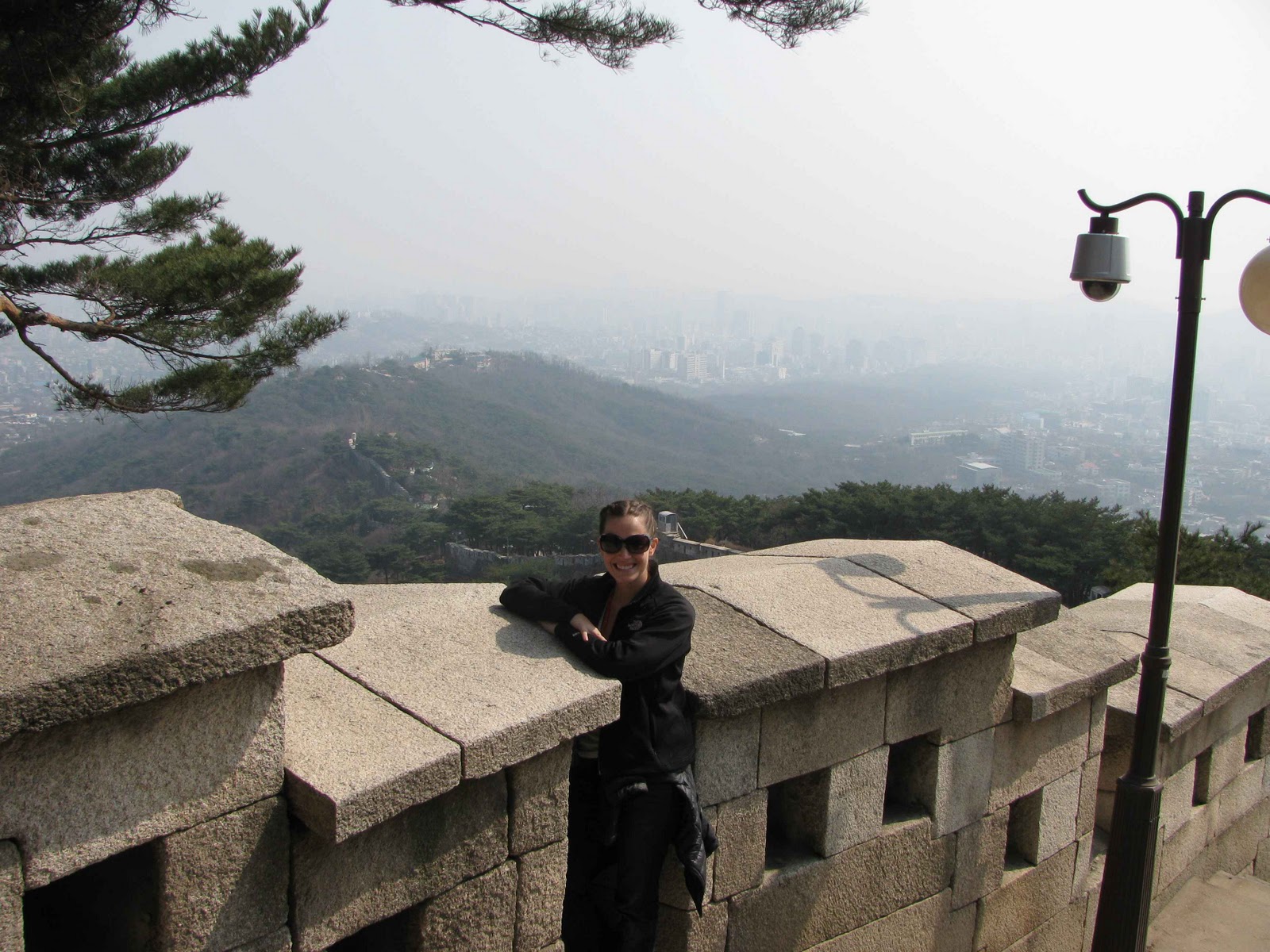
We climbed old fortress walls to the top of Mt Bugaksan where we were rewarded with stunning views of the city and made a new Korean friend who acted as our tour guide for the rest of the day (pointing out the nearby presidential palace, the bullet holes in a nearby tree and more).  In return, I promised to give his daughter advice on going to U.S. law school.  Little does he know that I’ll likely persuade her that law school is a waste of time and his dreams of a comfortable retirement will be crushed.

We stared in awe at the timbered roofs painted with brightly-colored, delicate patterns in the 15th century Changdeokgung Palace.  The side trip to the “Secret Garden” was a lot less rewarding and with an additional entrance fee of 5000 won ($5) a piece mere highway robbery  (okay, maybe that’s an exaggeration but it certainly wasn’t worth the hype in negative 2 degree weather without an English-speaking guide).

We went to a performance of JUMP, a non-verbal show with Marx Brothers-like slapstick interwoven with unbelievably impressive martial arts, wandered through the Ssamzie-gil art gallery where I only bought one pair of earrings despite wanting 50 and admired the tokens of love that teenage Koreans leave at Seoul Tower in the form of wall tiles and locks with love notes attached.


We’ve also fallen in love with heated floors, hand sanitizers in the subway, dumplings made by Korean grandmothers and getting lost in small alleyways full of hidden treasures.

Wednesday, March 23, 2011

The closest we’ll ever come to active landmines


If you ever feel you need a healthy dose of reality to believe that the world is not always a warm and fuzzy place then the Korean DMZ (De-Militarized Zone) should be first on your list of places to visit.  You may vaguely remember hearing a lot about the end of the Cold War when you were 10, but here its vestiges are alive and well.  Our USO tour bus left Seoul early and took us as far as the American-South Korean base and from there we switched to a military bus to take us through to the Joint Security Area (JSA).  Crossing a seemingly innocuous bridge our army host told us that the concrete walls were anti-tank pylons, the fields next to us were land-mined, and the barbed wire fence right after it was electrified.  I nearly choked on my Hello Kitty lollipop.

As he went on, we were surprised to learn that there were villages in the DMZ, one belonging to the South Koreans and the other to the North.  In the South, villagers plant rice fields and, aside from enduring very strict curfews, lead what sounds like a normal life (albeit with the constant threat of war breaking out around them).  In the North, Propaganda Village actually remains empty although the official position of the North Korean government is that it is a thriving 200-person collective farm.  Until 2004, loudspeakers in the empty village blared communist ideology with the aim of convincing South Koreans to defect to the North – thus the nickname. 


The JSA, however, was certainly the most unsettling place.  The area is divided up into buildings that belong to both North and South Koreans with shared conference rooms in the center.*  From the South Korean side, soldiers remain at a ready in a modified taekwondo stance, fists clenched and partially concealed behind buildings making them more difficult targets for sudden gunfire.  On the opposite side, two North Koreans march from behind pillars and frequently take out binoculars to examine each and every face in your tour group.  It’s hard not to imagine a huge wall inside that now has our pictures on it.


The tour finished at the Third Tunnel.  As North Koreans defected to the South, some of them carried information pertaining to the location of huge tunnels that the North had built under the DMZ with Seoul as the final target.  Unlike the miniature Cύ Chi tunnels built by the Vietnamese, these are proper tunnels (midgets like Tia don’t even need to duck).   Some of the rocks still have the black paint applied by the North Koreans to corroborate their claim that the tunnels were just old coal mines if ever accidentally discovered.  Four tunnels have currently been found but the South Koreans suspect that there might be many more.  It’s like living in a 1950s spy novel!


In stark contrast to the palpable tension is the comical game of one-upmanship.  South Korea constructs a building meant to host reuniting families and North Korea puts up another building just opposite that’s taller.  South Korea raises a 100 ft. flagpole and North Korea erects one that’s twice as tall (with a 600 lb. flag flying!).  If there are people who believe that modern nation states don’t do their fair share of primitive penis waving this should dispel that illusion. 


Saddest part: the perfectly new, fully functional railroad station at Dorasan with train times appearing on the electronic board but whose track ends just before the DMZ.   Families wait in the lobby praying to be reunited with their families stuck in the North.  Absolutely heartbreaking.


* - In the past, the buildings were scattered around the entire compound but that didn’t end so well (ref. axe murder incident).

Tuesday, March 22, 2011

Polite people + PETA pleasures = paradise

Holy crap, we didn't think it was possible to be blown away by any place anymore, but Seoul knocked our socks off. From the first moment we arrived in the city by airport bus, freezing cold and lost, a kindly businessman out on a date stopped and asked, in perfect English, whether we needed help finding our way. Call me cynical but the last time a friendly couple offered to "help" it was to charge me to fix a 3-inch spike they themselves put in the tire of my sister's car. Evidently, this guy had nothing up his sleeve because his directions got us to our guesthouse in no time. And this continued to happen every time we paused to gain our bearings, with one gentleman looking so genuinely concerned for us that we started to walk decisively just to alleviate the guilt we felt for worrying him so much. At one point all of Starbucks stopped working to look up directions to Changuimun for us on their mobile devices and a girl volunteered to walk us five minutes down the street (in her apron) to the actual bus station! Unbelievable.
Another old man approached us idling in a park and, upon finding out we were from the States, told us how thankful (pronounced tank-ful) he was for the Americans who came to help South Korea in the 1950s when they were starving. I didn't think anyone liked America anymore!*

Wandering through Insadong back alleys, we came across a number of appealing restaurants and found ourselves trying to match Korean characters on Lonely Planet with the signs in front of us (with little success). Choosing Yetchatjip, a traditional tea house, we ascended rickety wooden steps and slipped off our shoes before seating ourselves on floor mats. The chrysanthemum tea was divine, the double harmony tea more like sweetened motor oil. But the ambience couldn't be beaten: songbirds chirped above our heads and flitted freely from perch to perch in the tea house. We don't know how they kept them from crapping in the teacups but somehow it worked.

Our next stop brought us to Sanchon, a restaurant whose menu is based on food Buddhist monks would eat: a vegetarian's paradise, like much of Seoul. Twenty courses of mostly unidentifiable greens, including traditional kimchi (pickled cabbage), radishes, porridge, soybean stew, wild roots, fried kelp, and something I like to call mushroom twizzlers. All of it may have turned me on to vegetarianism (and simultaneously turned Tia off).

Also, everyone here speaks basic English and many speak well. Those who can only manage a few words, apologize (in English) and make us feel like real asses for not doing a better job of learning their language. It's surprising that few other Americans have discovered this place.

* - to be fair, he said the older generation was thankful but that the younger generation didn't feel the same way.